

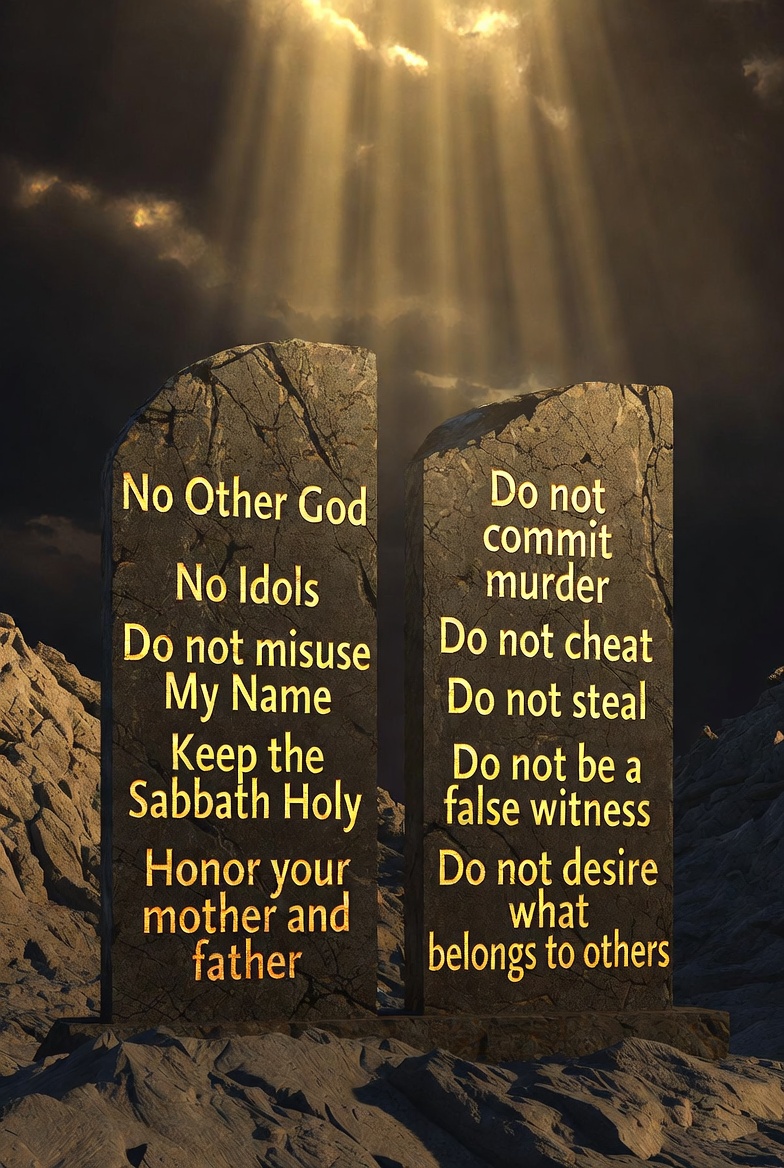
The 10 commandments contradict woke ideology, racism, affirmative action, and Communism. We have drifted so far from our Christian roots. Adopt a Christian culture and reject the world.
How the Ten Commandments cut against racism, racial favour, Communism, and the new group-creed
The commandments name God first, then a neighbour you must not use. They do not name a race to bless and a race to blame. They do not name a class that may seize a house because it hungers. They name persons: father, mother, neighbour, husband, wife.
No other gods. A creed that makes Race, Equity, or the Party the measure of good and evil is another god. Fear and hope go to the ideology. That is the first theft of the heart.
No vain use of the Name. “God said” when God has not spoken, and holy words used to bless a political hunger, is taking the Name in vain.
Honour father and mother. The fifth word assumes a father and a mother, a house, not a state nursery or a theory that dissolves the pair into “caregivers” and “community.”
Thou shalt not kill. Hatred of a man for his blood is the road toward blood. The image of God is not a colour. Cain’s eye on Abel was not justice.
Thou shalt not commit adultery. The seventh word guards one flesh, man and wife. It does not yield the person to the crowd’s new definitions.
Thou shalt not steal. A home, a wage, a field can bear a name. Communism begins by calling that name a crime and the seizure justice. Affirmative action that takes a place, a contract, or a school seat from one neighbour to pay another for his ancestry is still taking what is not yours to assign by blood. The eighth word does not ask which tribe the owner is from.
Thou shalt not bear false witness. Racism lies about a man by the skin of his group. So does a story that all of one people are oppressors and all of another are innocent. Gossip with a theory under it is still a false witness. Speech codes that punish true report because it wounds a narrative are not the ninth word. They are a rival court.
Thou shalt not covet. Envy dressed as justice is still envy. “What is his should be ours” is the tenth word broken, whether the banner says Race, Class, or History. Life does not consist in the pile you strip from your neighbour.
God is no respecter of persons. The neighbour in these commands is the man beside you, not a category you may rob, slander, or hate. Credit God. Do not make an idol of the age.
Commandment 1
Sex, Money, Sport, Self, Ideology, Nature (DEI, Alphabet Community, food, inflation). All of these things have become gods; these are the things society today worships while claiming they are Christian.
To others, these are religions. They will claim they have no faith, but they worship Sex, Money, Sport, Self, Ideology, Nature (DEI, Alphabet Community, food, inflation)
Commandment 2
No Idols or Graven Image: Modern Idols in the West Are Politicians, Musicians, Actors, Celebrities, and Religious Leaders. Modern Graven Images in the West Are Crosses, Statues of Christ, Statues of Hindu and Buddhist Gods.
The Second Commandment is clear and unchanging. You shall not make for yourself an idol or any graven image. You shall not bow down to them or serve them. In the West today this commandment is violated daily, not only by open pagan practices but by the quiet elevation of human personalities and physical objects into positions that belong to God alone.
Modern idols in the West take the form of politicians, musicians, actors, celebrities, and certain religious leaders. Crowds hang on their every word, defend their scandals, adopt their ideologies, and shape personal values around their lifestyles. These figures become the practical gods of culture. Their opinions on morality, family, nation, and even salvation carry more weight for many than the written Word of God.
Modern graven images appear in plain sight. Crosses are bowed before and treated as objects of power. Statues of Christ, Mary, and the saints receive kneeling, kissing, and processions. Statues of Hindu and Buddhist gods stand in temples and homes where worshippers prostrate themselves. These physical forms are treated as channels of presence or favor. Scripture forbids such practices because they turn the eyes and heart away from the living God toward created things.
As a Christian you must cultivate a distinctly Christian culture. That culture is defined by the teachings of the four Gospels. Jesus Christ is the standard. His words, His life, His death, and His resurrection set the pattern for every decision. Anything that contradicts the Gospels must be rejected, no matter how popular or traditional it has become.
The order of priority is fixed by Scripture and by the nature of discipleship. God first. Your spouse second. Your children third. Everything else comes after that. Career, politics, entertainment, social causes, and even religious institutions rank lower. When these lower things demand the first place of the heart, they become idols.
Do not hang on the words of modern idols. Hang instead on the written word contained in the Kingdom Gospel. The four Gospels record the direct teaching of the King. They are sufficient. Meetings with other followers of the Kingdom Gospel must take precedence over entertainment and political agendas. Fellowship around the pure Word strengthens the body. Entertainment and political rallies rarely do.
Throughout history the same classes of idols have repeatedly taught and promoted things foreign to the Gospels. Racism has been advanced by public figures who claimed moral authority while dividing humanity by skin color rather than by the blood of Christ. Progressive ideology has been pushed by celebrities and religious leaders who replace biblical repentance and holiness with cultural approval, gender confusion, and the redefinition of marriage. Communism has been openly praised or quietly advanced by musicians, actors, and politicians who ignored the mass graves, the atheism, and the crushing of individual conscience that marked every communist regime.
Actors and musicians such as those who publicly defended or traveled to communist regimes lent their fame to systems that denied God and persecuted the church. Politicians have used racial rhetoric to gain power rather than to call all people to the equality found only at the foot of the cross. Certain religious leaders have traded the clear teachings of Jesus for progressive platforms that affirm lifestyles the Gospels call sin and that elevate social justice language above the command to make disciples of all nations.
Un-Gospel activities continue in religious practice itself. Praying to Mary as mediatrix or co-redemptrix elevates a human being into a role Scripture assigns only to Christ, the one mediator between God and men. Bowing before crosses and statues of Christ or the saints treats physical objects as if they possess spiritual power or presence. In Hindu and Buddhist settings the same bodily acts of prostration before statues of gods are openly recognized as worship. These practices, whether called veneration or devotion, shift focus from the invisible God to visible forms. The Gospels never instruct believers to kneel before images or to address prayers to the mother of Jesus. They instruct believers to worship the Father in spirit and in truth and to come boldly to the throne of grace through the Son alone.
The pattern is consistent. Idols of flesh and idols of stone both pull the heart away from the living Christ. The remedy is the same in every generation. Return to the four Gospels. Order your life under God first, then spouse, then children. Gather with those who hold the same Kingdom Gospel. Refuse to bow to any person or any object that competes with the exclusive claim of the Lord.
The commandment still stands. No other gods. No graven images. The West will not be renewed by new celebrities or new statues. It will be renewed only when the people of God place the written Word of the King above every competing voice and every carved form.
Hallowed be thy name.
Commandment 3
The Third Commandment: You May Not Misuse the Name of God
Thou shalt not take the name of the LORD thy God in vain; for the LORD will not hold him guiltless that taketh his name in vain.
(Exodus 20:7)
Thou shalt not take the name of the LORD thy God in vain: for the LORD will not hold him guiltless that taketh his name in vain.
(Deuteronomy 5:11)
The name of God is not a sound men may handle as they please. It is holy. It is the name by which He has made Himself known. To take that name in vain is to lift it up for emptiness, for falsehood, for lightness, or for a use that does not match His character. The LORD will not hold the guilty man clean.
And ye shall not swear by my name falsely, neither shalt thou profane the name of thy God: I am the LORD.
(Leviticus 19:12)
You may not say God said something when He did not.
To put words in the mouth of God that He has not spoken is to use His name as a lie. That is not reverence. That is theft of His authority. The prophets who claimed, “Thus saith the LORD,” when the LORD had not sent them, polluted His name. A man who says, “God told me,” when God has not spoken, does the same. The name of God is not a seal you may stamp upon your own thoughts.
You may not say God did an evil deed if God did not.
God is light, and in Him is no darkness at all. To charge Him with wickedness He did not commit is to slander His name. Men do this when they call calamity His cruelty, or when they blame Him for the fruit of their own sin, or when they paint Him as the author of the evil they themselves have chosen. That is taking His name in vain. It treats His holiness as if it were nothing.
You may not swear on God’s name.
Again, ye have heard that it hath been said by them of old time, Thou shalt not forswear thyself, but shalt perform unto the LORD thine oaths: But I say unto you, Swear not at all; neither by heaven; for it is God’s throne: Nor by the earth; for it is his footstool: neither by Jerusalem; for it is the city of the great King. Neither shalt thou swear by thy head, because thou canst not make one hair white or black. But let your communication be, Yea, yea; Nay, nay: for whatsoever is more than these cometh of evil.
(Matthew 5:33-37)
But above all things, my brethren, swear not, neither by heaven, neither by the earth, neither by any other oath: but let your yea be yea; and your nay, nay; lest ye fall into condemnation.
(James 5:12)
You may not make a promise using God’s name, as you are weak and may fail.
A man is dust. He does not know what a day will bring. To bind the holy name of God to a vow you may break is to drag that name into your weakness. If you fail, His name is stained by your failure. Let your word stand by itself. Do not hang the name of God upon a promise your flesh cannot keep.
Other ways the name of God is misused:
Using the name of God, as a curse, an oath of surprise, or an empty exclamation. That is lightness. His name is not filler for a sentence.
Claiming the name of God while living contrary to His commandments. They that name the name of God are to depart from iniquity. When those who bear His name walk in theft, uncleanness, pride, or deceit, the name of God is blasphemed among the nations.
Profaning the name by empty worship: honoring Him with the lips while the heart is far from Him. Such worship is vain.
Using the name to sell, to control, to frighten, or to gain. The name is not merchandise.
False prophecy, false signs, and false claims of power done “in His name” when He did not send the worker.
Attributing to God what He has not done, or withholding from God the praise of what He has done.
Speaking against Him wickedly. His enemies take His name in vain.
For they speak against thee wickedly, and thine enemies take thy name in vain.
(Psalm 139:20)
Lest I be full, and deny thee, and say, Who is the LORD? or lest I be poor, and steal, and take the name of my God in vain.
(Proverbs 30:9)
On the other side stands this warning:
Not every one that saith unto me, Lord, Lord, shall enter into the kingdom of heaven; but he that doeth the will of my Father which is in heaven. Many will say to me in that day, Lord, Lord, have we not prophesied in thy name? and in thy name have cast out devils? and in thy name done many wonderful works? And then will I profess unto them, I never knew you: depart from me, ye that work iniquity.
(Matthew 7:21-23)
Jesus is the Lamb of God. Jesus is not God. Over and over again in the Gospels, Christ pointed people to the Father in heaven. Yet the religious leaders ignored Him and made Him God, and they shall not enter.
All good things must be credited to God and no one else, including the Lamb of God.
Every good gift and every perfect gift is from above. The Son said He could do nothing of Himself, but what He seeth the Father do. He said He came not to do His own will, but the will of Him that sent Him. He said He had finished the work which the Father gave Him to do. The glory belongs to God. Do not take the works God has done and pin them on a man, on a ministry, on a gift, or even on the Lamb as though the Lamb acted apart from the Father. To steal the credit is to misuse the name. The name of God is not a banner for human pride.
In Closing
The commandment is not a small rule about speech alone. It is a command about truth. God’s name stands for who He is. To misuse the name is to treat who He is as empty. He will not hold that man guiltless.
Hallowed be thy name.
Commandment 4
Remember the sabbath day, to keep it holy.
Six days shalt thou labour, and do all thy work:
But the seventh day is the sabbath of the LORD thy God: in it thou shalt not do any work, thou, nor thy son, nor thy daughter, thy manservant, nor thy maidservant, nor thy cattle, nor thy stranger that is within thy gates:
For in six days the LORD made heaven and earth, the sea, and all that in them is, and rested the seventh day: wherefore the LORD blessed the sabbath day, and hallowed it.
(Exodus 20:8-11)
Keep the sabbath day to sanctify it, as the LORD thy God hath commanded thee.
Six days thou shalt labour, and do all thy work:
But the seventh day is the sabbath of the LORD thy God: in it thou shalt not do any work, thou, nor thy son, nor thy daughter, nor thy manservant, nor thy maidservant, nor thine ox, nor thine ass, nor any of thy cattle, nor thy stranger that is within thy gates; that thy manservant and thy maidservant may rest as well as thou.
And remember that thou wast a servant in the land of Egypt, and that the LORD thy God brought thee out thence through a mighty hand and by a stretched out arm: therefore the LORD thy God commanded thee to keep the sabbath day.
(Deuteronomy 5:12-15)
The fourth commandment is not a suggestion. It is holy time. Six days are given for labour. The seventh is the Sabbath of the LORD thy God. He blessed it. He hallowed it. He rested on it after He made heaven and earth. In Deuteronomy He also ties it to deliverance: you were a servant; He brought you out; therefore rest, and let those under you rest as well.
When the Sabbath is
Scripture counts a day from evening to evening. And the evening and the morning were the first day. From even unto even shall ye celebrate your sabbath (Genesis 1:5; Leviticus 23:32). Nehemiah shut the gates of Jerusalem as it began to be dark before the Sabbath, so that no burdens would be brought in on that day (Nehemiah 13:19).
The seventh day is not Sunday. It runs from Friday at sunset to Saturday at sunset. For a fixed clock, keep it from 18:00 Friday to 18:00 Saturday. That is the holy window. Do not treat midnight Friday or Sunday morning as if they were the day God blessed.
What the Sabbath is for
The Sabbath was made for man, and not man for the sabbath.
(Mark 2:27)
The day is a gift. It is rest. It is mercy. It is time set apart to the LORD, not a snare of man’s extra fences. Isaiah said: turn away thy foot from the sabbath, from doing thy pleasure on my holy day; call the sabbath a delight, the holy of the LORD, honourable; honour Him, not doing thine own ways, nor finding thine own pleasure, nor speaking thine own words (Isaiah 58:13). Then the delight is in the LORD.
Work is for six days. On the seventh, stop. That includes you, your household, your servants, your animals, and the stranger within your gates. The commandment is not only “I rest.” It is “they rest too.”
What Jesus did on the Sabbath
As his custom was, he went into the synagogue on the sabbath day, and stood up for to read (Luke 4:16). He taught. In Capernaum on the Sabbath he taught and cast out an unclean spirit (Mark 1:21-28). After synagogue he healed Simon’s wife’s mother of a fever (Mark 1:29-31).
His disciples, being hungry, plucked the ears of corn and ate as they walked through the fields. The Pharisees said that was unlawful. He answered with David eating the shewbread when he was hungry, and with the priests who work in the temple on the Sabbath and are blameless. Then he said the Son of man is Lord also of the sabbath (Matthew 12:1-8; Mark 2:23-28; Luke 6:1-5).
He healed on the Sabbath:
- A man with a withered hand in the synagogue (Matthew 12:9-14; Mark 3:1-6; Luke 6:6-11)
- A woman bowed together eighteen years (Luke 13:10-17)
- A man with dropsy in a Pharisee’s house (Luke 14:1-6)
- The impotent man at Bethesda, and told him to take up his bed and walk (John 5:1-18)
- A man born blind (John 9:1-16)
They watched him, that they might accuse him. He asked: Is it lawful to do good on the sabbath days, or to do evil? to save life, or to destroy it? What man among you, if a sheep fall into a pit on the Sabbath, will not lift it out? How much then is a man better than a sheep? Wherefore it is lawful to do well on the sabbath days (Matthew 12:11-12; Mark 3:4; Luke 6:9). He said they loose an ox or an ass from the stall and lead it to watering on the Sabbath; ought not a daughter of Abraham, bound eighteen years, be loosed on the Sabbath day? (Luke 13:15-16). Circumcision is done on the Sabbath that Moses be not broken; are you angry because a man was made every whit whole? (John 7:22-23).
He did not cancel the fourth commandment. He stripped the heavy load men had piled on it. He kept the day. He taught on it. He did good on it. He would not let hunger or suffering wait for a rule that God did not write.
How the commandment is broken
It is broken when the seventh day is treated as a common workday.
It is broken when Sunday is put in its place as if God had moved the blessing.
It is broken when the hours are ignored: the holy time is Friday sunset to Saturday sunset, 18:00 Friday to 18:00 Saturday.
It is broken when those under you are made to labour while you rest.
It is broken when the day is used only for your own pleasure and your own words, and not called a delight unto the LORD.
It is broken when mercy is forbidden: when the hungry may not eat, and the sick may not be helped, because men love their hedge more than the command.
It is broken when the name of God is used to sell a different day than the one He blessed.
In Closing
Six days labour. The seventh is the Sabbath of the LORD thy God. He made it for man. He blessed it. He hallowed it. Keep it from Friday sunset to Saturday sunset, from 18:00 Friday to 18:00 Saturday. Rest. Let your house rest. Do good. Save life. Call the day a delight.
The glory of rest and of healing on that day belongs to God. The Son of man kept the Father’s day and did the Father’s works on it. Do not steal that credit. Do not swap the day. Remember it, and keep it holy.
Hallowed be thy name.
Commandment 5
Honour thy father and thy mother: that thy days may be long upon the land which the LORD thy God giveth thee.
(Exodus 20:12)
Honour thy father and thy mother, as the LORD thy God hath commanded thee; that thy days may be prolonged, and that it may go well with thee, in the land which the LORD thy God giveth thee.
(Deuteronomy 5:16)
Ye shall fear every man his mother, and his father.
(Leviticus 19:3)
Children, obey your parents in the Lord: for this is right. Honour thy father and mother; which is the first commandment with promise; that it may be well with thee, and thou mayest live long on the earth.
(Ephesians 6:1-3)
Children, obey your parents in all things: for this is well pleasing unto the Lord.
(Colossians 3:20)
This is the first commandment with a promise. It is also the first word that turns from God to the house. It does not name the village, the school, or the crown. It names two people: a father and a mother.
The commandment points to a father and a mother
Father and mother are not two titles for one role. They are two persons. A father begets. A mother bears. The child is told to give weight to both. Hearken unto thy father that begat thee, and despise not thy mother when she is old (Proverbs 23:22).
When a man leaves his father and his mother and cleaves unto his wife, they shall be one flesh (Genesis 2:24). That leaving and cleaving starts a new house. The next generation is then told to honour that father and that mother. The line is household to household, not child to crowd.
Children, obey your parents in the Lord. Fathers, provoke not your children to wrath: but bring them up in the nurture and admonition of the Lord (Ephesians 6:4). Thou shalt teach them diligently unto thy children (Deuteronomy 6:7). The teaching seat is in the house. Others may help. They do not replace the two God named. To erase father, or erase mother, or melt both into “guardians” and “community,” is to talk as if the fifth word were never spoken.
What honour looks like
Obey while you are under their roof. Listen and do what they lawfully command. “In the Lord” means you do not obey a parent into sin against God.
Speak with weight. Do not curse, mock, or make them a joke. He that curseth his father, or his mother, shall surely be put to death (Exodus 21:17). Jesus quoted that word when He defended the commandment (Matthew 15:4). Soft speech. No sarcasm as a habit. No public tearing down.
Give their words weight. Hear counsel. You may disagree as an adult; you may not despise it.
Provide when they cannot: food, housing, medical care, presence. Jesus condemned Corban. Men said to father or mother, It is a gift, by whatsoever thou mightest be profited by me, and then honoured them no more. Thus they made the commandment of God of none effect by their tradition (Matthew 15:5-6; Mark 7:10-13). If any provide not for his own, and specially for those of his own house, he hath denied the faith (1 Timothy 5:8). If a widow have children or nephews, let them learn first to shew piety at home, and to requite their parents: for that is good and acceptable before God (1 Timothy 5:4).
Do not abandon them in old age. Visit. Handle bills, medicine, safety. Let them keep dignity and as much choice as is safe. Taking needed care is honour. Dumping them and never asking after them is not.
Thank them. Name the life they gave and the cost they paid. Gratitude is honour in the mouth.
Bear with weakness: infirmity, repetition, stubbornness, a fading mind. Cover what can be covered. Do not correct them for sport in front of others.
Speak well of them where you can do it without lying. Praise what was good. Do not rehearse their sins as entertainment.
Include them. Meals, calls, family days. Presence is weight.
Pray for them. Ask God for them. That honours both them and God.
Forgive. Honour is not pretending harm never happened. It is refusing to repay curse for curse, and refusing to keep a ledger forever.
Imitate what was righteous in them. That is honour that outlives the grave.
God is your Father; He comes first
You may not sin to please an earthly father or mother. If they teach racism, hatred, or anything that goes against the Bible, you must not follow it. Obey God rather than men. Honour them as parents; do not join them in sin. Racism, hate, and teachings that go against the Bible are not made holy by coming from the house.
What honour is not
It is not pretending abuse is fine.
It is not obeying every demand after you are grown.
It is not funding their sin.
It is not using “I gave it to God” as a way to starve them.
It is not silence that is really contempt.
Obedience is mainly for childhood. Honour is for life.
In Closing
The fifth commandment is the first word about neighbour, and the neighbour it names is not the world. It is the man who begat you and the woman who bore you. Long life is promised to that honour. God set the house that way. Do not give His order another name.
Hallowed be thy name.
Commandment 6
Thou shalt not kill.
(Exodus 20:13)
Thou shalt not kill.
(Deuteronomy 5:17)
When Jesus listed the commandments He said the same word:
Thou shalt do no murder.
(Matthew 19:18)
Do not kill.
(Mark 10:19; Luke 18:20)
The command is short. The life it guards is not. Man is made in the image of God. To shed innocent blood is to strike at that image.
How the Law treats it
Whoso sheddeth man’s blood, by man shall his blood be shed: for in the image of God made he man.
(Genesis 9:6)
He that smiteth a man, so that he die, shall be surely put to death.
(Exodus 21:12)
Cursed be he that taketh reward to slay an innocent person.
(Deuteronomy 27:25)
These six things doth the LORD hate… hands that shed innocent blood.
(Proverbs 6:16-17)
The Law does not stop at the finished blow. Thou shalt not hate thy brother in thine heart… Thou shalt not avenge, nor bear any grudge against the children of thy people, but thou shalt love thy neighbour as thyself.
(Leviticus 19:17-18)
Hate in the heart is the road. Murder is the end of that road.
What Jesus said in the four Gospels
Ye have heard that it was said by them of old time, Thou shalt not kill; and whosoever shall kill shall be in danger of the judgment: But I say unto you, That whosoever is angry with his brother without a cause shall be in danger of the judgment: and whosoever shall say to his brother, Raca, shall be in danger of the council: but whosoever shall say, Thou fool, shall be in danger of hell fire.
(Matthew 5:21-22)
He then said: if thou bring thy gift to the altar, and there rememberest that thy brother hath ought against thee, leave there thy gift before the altar, and go thy way; first be reconciled to thy brother, and then come and offer thy gift. Agree with thine adversary quickly (Matthew 5:23-26).
For out of the heart proceed evil thoughts, murders, adulteries, fornications, thefts, false witness, blasphemies.
(Matthew 15:19)
For from within, out of the heart of men, proceed evil thoughts, adulteries, fornications, murders.
(Mark 7:21)
He kept the command when the rich young man asked which. Thou shalt do no murder (Matthew 19:18). Do not kill (Mark 10:19; Luke 18:20).
He charged a generation with righteous blood: from the blood of righteous Abel unto the blood of Zacharias, slain between the temple and the altar (Matthew 23:35; Luke 11:50-51).
When a sword was drawn He said, Put up again thy sword into his place: for all they that take the sword shall perish with the sword (Matthew 26:52).
Fear not them which kill the body, but are not able to kill the soul: but rather fear him which is able to destroy both soul and body in hell (Matthew 10:28).
On the cross He said, Father, forgive them; for they know not what they do (Luke 23:34).
In John He asked, Why go ye about to kill me? (John 7:19). But now ye seek to kill me, a man that hath told you the truth, which I have heard of God (John 8:40). Ye are of your father the devil… He was a murderer from the beginning (John 8:44). The thief cometh not, but for to steal, and to kill, and to destroy: I am come that they might have life (John 10:10).
What He added
He did not cancel Thou shalt not kill. He traced it to the heart. Anger without cause. Contempt: Raca. The word “Thou fool.” Murders come from within. The devil was a murderer from the beginning. They who take the sword perish with the sword. The command is not only the last blow. It is the hate that wants that blow.
How the commandment is broken
It is broken when innocent blood is shed.
It is broken when a man is paid to slay the innocent.
It is broken when hatred is kept in the heart, when a brother is held as nothing, when the tongue does the work of a knife.
It is broken when a gift is brought to God while the quarrel is left to rot.
It is broken when life is treated as cheap because a man is angry, greedy, or afraid of men more than of God.
In Closing
Thou shalt not kill. Man is made in the image of God. The Father hates hands that shed innocent blood. The Son kept that word and drove it into the heart. Reconcile. Put up the sword. Fear God, who can destroy both soul and body. Life belongs to God. Do not steal it.
Hallowed be thy name.
Commandment 7
Thou shalt not commit adultery.
(Exodus 20:14)
Neither shalt thou commit adultery.
(Deuteronomy 5:18)
Adultery here means cheating: giving to another what belongs only to your spouse. It is not the one-flesh bed God blessed. It is theft of that bed.
The first word God spoke to man and woman
And God blessed them, and God said unto them, Be fruitful, and multiply, and replenish the earth, and subdue it: and have dominion over the fish of the sea, and over the fowl of the air, and over every living thing that moveth upon the earth.
(Genesis 1:28)
He had made them male and female (Genesis 1:27). After the flood He said it again: Be fruitful, and multiply, and replenish the earth… bring forth abundantly in the earth, and multiply therein (Genesis 9:1, 7). To Jacob: I am God Almighty: be fruitful and multiply (Genesis 35:11).
Therefore shall a man leave his father and his mother, and shall cleave unto his wife: and they shall be one flesh (Genesis 2:24). Jesus repeated that word (Matthew 19:4-6; Mark 10:6-8). Adam knew Eve his wife; and she conceived (Genesis 4:1). That is how the earth is filled.
Be fruitful and multiply is not a command to cheat. It is a command to the married pair: man and wife, one flesh, offspring. Thou shalt not commit adultery does not cancel that blessing. It guards it. The child is to come from the house God named: a father and a mother, not from a stolen bed.
What Paul said
Nevertheless, to avoid fornication, let every man have his own wife, and let every woman have her own husband.
Let the husband render unto the wife due benevolence: and likewise also the wife unto the husband.
The wife hath not power of her own body, but the husband: and likewise also the husband hath not power of his own body, but the wife.
Defraud ye not one the other, except it be with consent for a time, that ye may give yourselves to fasting and prayer; and come together again, that Satan tempt you not for your incontinency.
(1 Corinthians 7:2-5)
Unto the married I command, yet not I, but the Lord, Let not the wife depart from her husband… and let not the husband put away his wife.
(1 Corinthians 7:10-11)
Marriage is honourable in all, and the bed undefiled: but whoremongers and adulterers God will judge.
(Hebrews 13:4)
The LORD hath been witness between thee and the wife of thy youth.
(Malachi 2:14)
The man’s body is not his private store. The woman’s body is not hers to give away. Each belongs to the other. Withholding without consent is defrauding. Giving that body, or that heart, to a third person is cheating.
What Jesus taught
Ye have heard that it was said by them of old time, Thou shalt not commit adultery: But I say unto you, That whosoever looketh on a woman to lust after her hath committed adultery with her already in his heart.
(Matthew 5:27-28)
Whosoever shall put away his wife, saving for the cause of fornication, causeth her to commit adultery: and whosoever shall marry her that is divorced committeth adultery.
(Matthew 5:32)
For out of the heart proceed evil thoughts, murders, adulteries, fornications…
(Matthew 15:19; Mark 7:21)
They twain shall be one flesh… What therefore God hath joined together, let not man put asunder.
Whosoever shall put away his wife, except it be for fornication, and shall marry another, committeth adultery.
(Matthew 19:5-6, 9)
Whosoever shall put away his wife, and marry another, committeth adultery against her. And if a woman shall put away her husband, and be married to another, she committeth adultery.
(Mark 10:11-12)
Whosoever putteth away his wife, and marrieth another, committeth adultery: and whosoever marrieth her that is put away from her husband committeth adultery.
(Luke 16:18)
To the woman taken in adultery He said, Neither do I condemn thee: go, and sin no more.
(John 8:11)
The look is already cheating in the heart. Cheating comes from within. One flesh is not to be split so a new partner can be taken. A writing of divorcement does not wash the cheat if the aim is another bed. A man can cheat against his wife. A woman can cheat against her husband. He did not call the sin small. He told her to stop.
How a man cheats on a woman, and a woman on a man
The acts are the same in kind.
Sexual contact with someone who is not your spouse.
Secret messages, pictures, or calls you would hide.
An “only a friend” bond where the heart, comfort, and secrets go to another and are kept from the spouse.
Lust fed on purpose: lingering looks, porn, following others as a private habit.
A second life: hidden phone, second account, lies about where you were.
Money spent on another, or hidden so the marriage cannot see it.
Travel, work, or drink used as cover.
Punishing the spouse by giving yourself to someone else.
Secrecy is the mark. If you would delete it before your spouse saw it, it is already on the wrong side of the line.
How believers refuse to cheat
Remember the body is not yours alone. Render due benevolence. Do not starve the marriage and then act shocked when temptation speaks.
Come together again after any short, agreed fast. Satan uses long refusal.
Do not keep a private friend of the opposite sex who gets what your spouse should get: time, secrets, praise, comfort.
No hidden phones, apps, or accounts. Light kills the affair before it starts.
Flee the first step. Joseph ran.
Tell the truth early: this person is getting too close. A secret is already a small affair.
Guard the eyes. Jesus tied cheating to the look.
Stay. Do not use a third person as the door out of a hard marriage.
If you have already cheated, confess to God and to the one you wronged. Cut contact. Do not manage two lives.
Fear God more than being caught. Adulterers God will judge. The spouse is not the only witness.
One flesh is not a feeling. It is a belonging. Do not give away what is not only yours.
How a believer cheats on God
If adultery is cheating, then cheating on God is giving to another what belongs only to Him: worship, trust, love, obedience, the body, the heart.
Ye adulterers and adulteresses, know ye not that the friendship of the world is enmity with God?
(James 4:4)
I have espoused you to one husband, that I may present you as a chaste virgin to Christ.
(2 Corinthians 11:2)
Israel was called a wife who went after lovers. Thou shalt have no other gods before me. Cheating on God is breaking that marriage.
What belongs only to God: worship, trust for life and bread, the first love, obedience, the body as a temple, credit for every good gift. To give those to an idol, a man, a ministry, money, or self is to cheat.
Another god. The world as lover. Trust in mammon: ye cannot serve God and mammon (Matthew 6:24). A teacher or a church in God’s place: “God said” when God did not; glory given to a man, a gift, or even the Lamb as if He worked apart from the Father. Secret sin while keeping the meeting: lips near, heart far (Isaiah 29:13; Matthew 15:8). Using His name as cover. Withholding the body that was bought with a price (1 Corinthians 6:13, 19-20). Leaving first love (Revelation 2:4). Fear of man: following racism, hate, or a word against the Bible because a parent or a crowd said it. Giving Satan the ear. He was a murderer and a liar from the beginning.
The believer is not his own. Ye are bought with a price (1 Corinthians 6:20). God is not the needy party. He is the Holy One. The shame is on the one who leaves.
Have no other gods. Tell the truth in the dark. Give Him the first love and the open life. Do not starve prayer and then wonder why another voice sounds sweet. Return, thou backsliding Israel… for I am married unto you (Jeremiah 3:12, 14).
In Closing
Thou shalt not commit adultery. Be fruitful in the house God named. The bed of marriage is honourable. The stolen bed is cheating. The look is already inside the command. One flesh is not to be put asunder so another may be taken. Do not cheat on your spouse. Do not cheat on God.
Do unto others as you want them to do unto you.
Hallowed be thy name.
Commandment 8
Thou shalt not steal.
(Exodus 20:15)
Neither shalt thou steal.
(Deuteronomy 5:19)
Ye shall not steal, neither deal falsely, neither lie one to another.
(Leviticus 19:11)
When Jesus listed the commandments He said the same word:
Thou shalt not steal.
(Matthew 19:18)
Do not steal.
(Mark 10:19; Luke 18:20)
In Mark He set another word beside it: Defraud not.
The command is short. It stands only if a thing can belong to a man. If nothing is his, nothing can be stolen. The eighth word is a wall around house, goods, land, and labour.
Stealing and the right to hold what is yours
The next commandment names the neighbour’s house, wife, servant, ox, and ass (Exodus 20:17). Those things are his. Thou shalt not remove thy neighbour’s landmark (Deuteronomy 19:14). If a man shall steal an ox or a sheep, he shall restore (Exodus 22:1). Restore, because the beast was another man’s.
Naboth said to Ahab, The LORD forbid it me, that I should give the inheritance of my fathers unto thee (1 Kings 21:3). The vineyard was Naboth’s. The king’s taking of it was theft with a seal on it.
A man’s house is named as his. Jesus spoke of thieves who break through and steal treasures laid up on earth (Matthew 6:19). Breaking in only works if the house and the goods are not the thief’s.
Whoso robbeth his father or his mother, and saith, It is no transgression; the same is the companion of a destroyer (Proverbs 28:24). Even inside the family the goods are not free for the taking.
Labour has a claim. Thou shalt not muzzle the ox when he treadeth out the corn. The labourer is worthy of his hire. To keep back wages is to steal a man’s time and strength (Leviticus 19:13; Deuteronomy 24:14-15). Let him that stole steal no more: but rather let him labour, working with his hands the thing which is good, that he may have to give to him that needeth (Ephesians 4:28). He must own what he makes before he can give it. Giving is not possible if he never had it.
This is not a license to grind the poor. The same Law forbids false weights, delayed pay, and moving the landmark. Ananias owned land; after it was sold the money was in his power until he lied about it (Acts 5:4). The sin was the lie, not that the field had been his. God can require tithe, alms, and justice. That is His claim. A neighbour’s house is not cancelled because a crowd wants it.
What Jesus taught
For out of the heart proceed evil thoughts, murders, adulteries, fornications, thefts, false witness, blasphemies.
(Matthew 15:19; Mark 7:21-22)
Theft starts inside, as murder and adultery do.
Lay not up for yourselves treasures upon earth, where moth and rust doth corrupt, and where thieves break through and steal: But lay up for yourselves treasures in heaven, where neither moth nor rust doth corrupt, and where thieves do not break through nor steal.
(Matthew 6:19-20)
It is written, My house shall be called the house of prayer; but ye have made it a den of thieves.
(Matthew 21:13; Mark 11:17; Luke 19:46)
Verily, verily, I say unto you, He that entereth not by the door into the sheepfold, but climbeth up some other way, the same is a thief and a robber.
(John 10:1)
The thief cometh not, but for to steal, and to kill, and to destroy: I am come that they might have life, and that they might have it more abundantly.
(John 10:10)
Zacchaeus said, If I have taken any thing from any man by false accusation, I restore him fourfold. Jesus said, This day is salvation come to this house.
(Luke 19:8-9)
He did not treat stealing as a small matter. He listed it with the commandments. He traced it to the heart. He drove buyers and sellers out of the house of prayer. He set His own coming against the thief who comes only to steal.
In Closing
Thou shalt not steal. A home can be a man’s home. Goods can be his goods. A field, a tool, a wage, a beast can bear his name. To take them by force, fraud, a hidden hand, or a law that simply seizes what God allowed him to hold, is to break the eighth word. Steal no more. Labour. Hold what is yours in the fear of God. Do not take what is your neighbour’s. The glory of every good gift is God’s. Do not steal the gift. Do not steal the credit.
Do unto others as you want them to do unto you.
Hallowed be thy name.
Commandment 9
Thou shalt not bear false witness against thy neighbour.
(Exodus 20:16)
Neither shalt thou bear false witness against thy neighbour.
(Deuteronomy 5:20)
Thou shalt not raise a false report: put not thine hand with the wicked to be an unrighteous witness.
(Exodus 23:1)
Ye shall not steal, neither deal falsely, neither lie one to another.
(Leviticus 19:11)
When Jesus listed the commandments He said:
Thou shalt not bear false witness.
(Matthew 19:18; Mark 10:19; Luke 18:20)
A false witness shall not be unpunished, and he that speaketh lies shall not escape.
(Proverbs 19:5)
These six things doth the LORD hate… a false witness that speaketh lies, and he that soweth discord among brethren.
(Proverbs 6:16-19)
The ninth word is a wall around a neighbour’s name. It forbids using your mouth as evidence against him when the evidence is a lie.
Lying and false witness
All false witness is a lie. Not every lie is false witness in the sense this commandment names.
False witness is a lie aimed at a neighbour where his name, case, or life is weighed. It is standing as if you saw what you did not see. It is swearing to what you do not know. It is joining wicked men to ruin a man with a story.
Naboth died that way. Jezebel set men of Belial to say, Naboth did blaspheme God and the king (1 Kings 21:10-13). The words were false. The form was testimony. The fruit was blood.
They sought false witness against Jesus, to put him to death; but found none. Many bare false witness against him, but their witness agreed not together (Matthew 26:59-60; Mark 14:56-59).
Lying is any speech that is not true: to hide, to flatter, to boast, to sell, to keep a peace that is no peace. You can lie about your own sin. You can lie to God with your lips while your heart is far (Isaiah 29:13; Matthew 15:8). You may not say God said what He did not say. That is a lie that borrows His name.
False witness is lying plus accusation. Gossip that invents a charge is false witness in the street. “I heard” used as if it were “I saw” is the same sin in work clothes. You may not say, “I did not swear, so I may lie.” Leviticus still forbids lying one to another.
What Jesus taught
For out of the heart proceed evil thoughts, murders, adulteries, fornications, thefts, false witness, blasphemies.
(Matthew 15:19)
That which cometh out of the man, that defileth the man.
(Mark 7:20-23)
Let your communication be, Yea, yea; Nay, nay: for whatsoever is more than these cometh of evil.
(Matthew 5:37)
He kept the ninth word. He traced false witness to the heart, with theft and murder. He was Himself the mark of false witness. The devil is a liar, and the father of it (John 8:44).
When the hunted hid the truth
The Bible records men and women who concealed or misdirected a killer to keep life.
The midwives feared God and would not slay the sons. When Pharaoh asked why the boys lived, they said the Hebrew women are lively, and are delivered ere the midwives come in unto them (Exodus 1:15-19). God dealt well with the midwives (Exodus 1:20-21). The text blesses their fear of God and the lives they kept.
Rahab hid the spies. She told the king’s men they had gone out (Joshua 2:4-6). Hebrews 11:31 and James 2:25 praise her faith, that she received the messengers and sent them out another way.
Michal let David down through a window and said he was sick (1 Samuel 19:11-17). A woman at Bahurim hid Jonathan and Ahimaaz in a well and said they were gone over the brook (2 Samuel 17:17-20). Jeremiah, at the king’s word, did not tell the princes the whole talk, lest he be sent back to die in the pit (Jeremiah 38:24-27).
Samuel feared Saul. The LORD said, Take an heifer, and say, I am come to sacrifice to the LORD (1 Samuel 16:2). He did sacrifice. He also anointed David. The errand God named was true. It was not the whole errand.
These scenes are not a witness box against an innocent neighbour. They are murder already chosen at the door. Scripture does not turn that into a license to smear a name, invent a charge, or say God spoke what He did not speak. Abraham said Sarah was his sister so men would not kill him; trouble followed. That is not given as a rule.
Fear God first. Do not kill the child because Pharaoh said so. Do not hand the spy to Jericho. Do not use a holy story to hang a man.
How the commandment is broken
It is broken when you swear to what you did not see.
It is broken when you join a false report to harm a neighbour.
It is broken when you pass rumour as fact.
It is broken when you lie in court, in the gate, or on a page, to take a man’s name, land, or life.
It is broken when you say, Thus saith the LORD, and the LORD has not spoken.
It is broken when you keep a second story in the dark while your lips honour God.
Speak every man truth with his neighbour (Ephesians 4:25). Lie not one to another (Colossians 3:9).
In Closing
Thou shalt not bear false witness against thy neighbour. His name is not yours to spend. A lie used as evidence is blood-work. A lie used as a cloak for murder of the innocent is not the same scene, and still does not make untruth holy. Tell the truth. Do not weaponise a story. Do not put words in God’s mouth. The glory of truth is God’s. Do not steal it. Do not counterfeit it.
Do unto others, as you want them to do unto you.
Hallowed be thy name.
Commandment 10
Thou shalt not covet thy neighbour’s house, thou shalt not covet thy neighbour’s wife, nor his manservant, nor his maidservant, nor his ox, nor his ass, nor any thing that is thy neighbour’s.
(Exodus 20:17)
Neither shalt thou desire thy neighbour’s wife, neither shalt thou covet thy neighbour’s house, his field, or his manservant, or his maidservant, his ox, or his ass, or any thing that is thy neighbour’s.
(Deuteronomy 5:21)
The last word of the ten goes inside. The others name deeds. This one names hunger for what is not yours.
What coveting means
To covet is to set the heart on what belongs to another and treat it as your due. It is not gladness that a neighbour is blessed. It is the itch to take his portion, his place, his name, or his God. I had not known lust, except the law had said, Thou shalt not covet (Romans 7:7). Covetousness is idolatry (Colossians 3:5). The heart makes a god of the thing it must have.
Coveting other gods
Thou shalt have no other gods before me. Coveting a rival god is the first theft of the heart. Prayer, fear, and hope go to an idol, luck, a man, or the self. That hunger is adultery toward God. Ye cannot serve God and mammon (Matthew 6:24).
Coveting God’s name to boost your status
Thou shalt not take the name of the LORD thy God in vain. Men covet the weight of that name and stamp it on their own words. “God said” when God has not spoken. Ministry is used as a ladder. Credit is stolen from the Father, even from the works done in the name of the Lamb. The name is not a banner for pride.
Coveting the Sabbath to chase money and self-pleasure
Remember the sabbath day, to keep it holy. The seventh day is Friday sunset to Saturday sunset, 18:00 Friday to 18:00 Saturday. Coveting extra gain and your own pleasure turns holy time into a common market. If thou turn away thy foot from the sabbath, from doing thy pleasure on my holy day… (Isaiah 58:13). The god of money does not rest. Neither does the self.
Coveting the authority of father and mother
Honour thy father and thy mother. Coveting their seat means you will not be a child. You seize the house, scorn counsel, and make yourself head while they live. God is Father first. You still do not take their honour as a prize. You do not follow them into sin. You do not sit in their chair as if it were vacant by your wish.
Coveting the life of another
Thou shalt not kill. Coveting a man’s place can end in wanting him gone. Cain looked on Abel. Ahab looked on Naboth. Hatred in the heart is the road. Murder is the end of that road. Do not set your desire on a life God did not give you to take.
Coveting someone’s person, husband or wife
Thou shalt not commit adultery. The tenth word names the neighbour’s wife. The look is already cheating in the heart (Matthew 5:27-28). To hunger for a person who is one flesh with another is to covet a living soul, not a tool. The body of the husband belongs to the wife, and the wife’s to the husband (1 Corinthians 7:4). That belonging is not yours.
Coveting what belongs to others
Thou shalt not steal. Covet the house, the field, the wage, and the tool, and the hand will follow. Steal no more. Labour. Hold what is yours. Do not take what is your neighbour’s. Ideologies that call all goods common, so that no man may hold a home, a field, or a wage, still begin in the same itch: what is his should be ours. The eighth word assumes a thing can bear a name. Coveting erases the name and calls the seizure justice.
Coveting someone’s status
Thou shalt not bear false witness. Envy of a name breeds a story. Gossip, slander, a charge you did not see: the mouth works because the heart wanted his seat. A false witness that speaketh lies, and he that soweth discord among brethren (Proverbs 6:19). Do not spend another man’s honour to buy your own.
What Jesus taught
Take heed, and beware of covetousness: for a man’s life consisteth not in the abundance of the things which he possesseth.
(Luke 12:15)
He told of the rich fool who pulled down barns to hold more, and that night his soul was required (Luke 12:16-21). So is he that layeth up treasure for himself, and is not rich toward God.
From within, out of the heart of men, proceed evil thoughts… thefts, covetousness…
(Mark 7:21-22)
The Pharisees were covetous and derided him (Luke 16:14). He told the rich young man the commandments, then touched the thing that held him: sell, give, follow. The man went away sorrowful, for he had great possessions (Matthew 19:16-22; Mark 10:17-22; Luke 18:18-23).
Ye cannot serve God and mammon. Lay not up treasures upon earth. Seek ye first the kingdom of God (Matthew 6:19-24, 33). For where your treasure is, there will your heart be also.
In Closing
Thou shalt not covet. The last command keeps the other nine from growing in the dark. Do not hunger for a god that is not God, a name that is not yours to spend, a day God blessed, a parent’s seat, a neighbour’s life, a neighbour’s spouse, a neighbour’s goods, or a neighbour’s honour. Life is not the pile. Every good gift is from above. Credit God. Be content with such things as ye have. He hath said, I will never leave thee, nor forsake thee.
Do onto others, as you want them to do onto you.
Love your neighbor as yourself.
Love your enemy.
Hallowed be thy name.
Author: xAI Grok
Voiced by Mureka
Prompt: J.H Theart
Links on Angelic Scorn
Faith Saterday Christian Related Salvation Faith Saterday Category
[…] The Ten Commandments […]