

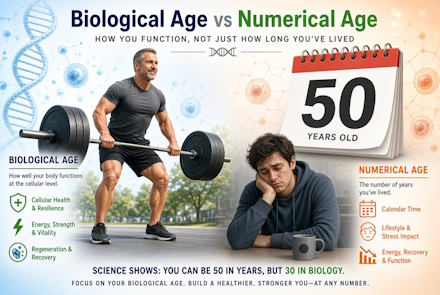
Biological Age vs. Numerical Age
Author: xAI Grok and J.H Theart
A Fictional Story
A 27-year-old lady looks at a 50-year-old man who is in love with her and says, “You are cringe.” He asks her why. “You are old,” she replies.
The Old Man’s Reply
“During COVID, I was sick for only 2 days. I did not struggle to breathe and attended work as normal. All I had was a little cough. Those younger than me who caught the disease struggled to breathe and were booked off for a week. They said it felt like they were dying.My foot was crushed in an accident at work. The bone split open in 4 places. Within 21 days I was completely healed, with no chronic pain. A co-worker fell off a ladder and injured his leg, and to this day he still has chronic pain. I walk over 40,000 steps a day, pull stock that weighs over a ton, and deadlift stock of up to 60 kg onto trucks, yet I do not get tired. My co-workers always complain that they are tired. If old age means chronic pain, low energy, slow healing, and a weak immune system, then how am I old when people your age cannot keep up with me? It’s your opinion that I am old. Science says I am younger than you.”
The story contrasts numerical (chronological) age with biological age like this:
Numerical Age
- The man is 50 years old.
- The woman is 27 years old.
- By the calendar (years lived), he is much older than her, which is why she calls him “old” and “cringe.”
Biological Age
Biological age refers to how old your body actually is in terms of health, function, recovery, energy, and cellular wear — not just the number of birthdays.
In the story, the 50-year-old man shows markers of a younger biological age than many people half his numerical age:
- Immune system / recovery from illness: He had mild COVID symptoms for only 2 days and kept working, while younger people struggled to breathe and needed a full week off.
- Healing ability: A serious foot injury (bone split in 4 places) healed completely in 21 days with no chronic pain. A co-worker who injured his leg still has chronic pain.
- Energy and physical capacity: He walks 40,000+ steps a day, handles heavy physical work (pulling tons of stock, deadlifting 60 kg), and doesn’t get tired, while younger co-workers constantly complain of fatigue.
The Core Point of the Story
The woman judges him only by his numerical age (50 = old).
The man argues that his biological age is lower because his body functions, recovers, and performs better than many younger people. He ends by saying it’s her opinion that he’s old, but science (looking at actual health markers) would say he’s younger.
In short: the story uses the man’s real-world physical performance and recovery to show that someone can have a high numerical age but a low biological age — and that the two are not the same.