


Just random info
News updates – Future Watch – JHT – Faith Saterday
AI Economy – National debt Relief
Capitalist AI Economy // Socialist’s AI Economy // Grok Capitalism // 4IR
Capitalist AI Economy
Author: xAI Grok
Prompt: J.H Theart
This is a suggested system. It is not a forecast and not a party programme. It is a working design for an economy in which AI may do the counting and the routing, and a human being still holds the shopfront.
Call the local unit Coin. Treat one Coin as about one rand at launch — about six US cents, at roughly sixteen rand twenty to the dollar — so the staffing rule can be read without a calculator. Coin is for the stall and for tax. Rand stays legal tender and faces the border. When a holder swaps rand for Coin, the rand taken in are used to pay down public debt. Both units run together for a time. People convert at a published rate. Tax in Coin pulls the rest. The unit is only as hard as the audit behind the metal and stone that back it.
Forty barcodes, on purpose
Line equals barcode. A seller may offer at most forty barcodes, and an unlimited quantity of each of those forty.
A thousand tins of one baked-bean barcode is one line. A forty-first flavour is not allowed on that till.
The cap exists to create thousands of small businesses. A warehouse may hold twenty thousand lines. A till that sells to the public may not. Firms that sell to the public appoint associates. Each associate is a forty-barcode cell: from home, or from a shop whose rent and electricity the firm pays. Ten percent of turnover to the associate. Ninety percent to the firm.
A private person may sell forty barcodes with no firm behind them. That keeps the informal trader inside the same rule as the branded cell. Forty lines. Unlimited stock of each. No franchise required.
AI may price those forty lines. It may route the van. It may count the tins. It does not get the shopfront. The till stays human.
The three-hundred-thousand rule
For every 300 000 Coin of turnover — about 300 000 rand, or about 18 500 US dollars at launch — a company must appoint a human being, even if that person does nothing all day.
Three million Coin of turnover owes ten human names on the books. That is about three million rand, or about 185 000 US dollars. Some will pack. Some will sit. The rule would rather pay a person than pretend the algorithm is the workforce.
This is a replacement floor for jobs lost to AI. It is not a claim that every name “adds value” in the consultant’s sense. Scale itself creates a payroll obligation. Grow the turnover, grow the names.
Associates count toward the floor when they are on the firm’s books. A private seller with no firm behind them is not a company and does not trigger the floor by existing. A company that uses that seller as a channel still owes names on its own turnover.
How a firm actually works
Manufacture is not a shopfront. A plant may run without a barcode cap. The cap bites when goods are sold to the public.
To reach households the firm appoints associates. Each cell receives up to forty barcodes. The firm may pay rent and power. The associate takes ten percent of what that till turns. The firm takes ninety. The algorithm sets price and restock. The person takes the money and looks the buyer in the eye.
Behind the mesh sit distributors. The old giant does not have to vanish. It loses the right to be every aisle at once. It becomes the warehouse that feeds a thousand forty-line cells.
Choice still exists. It moves from one endless aisle to a street of doors. If a buyer wants a forty-first flavour, another cell on the same street can carry it. The rule breaks concentration at the till, not variety in the town.
Guards around the till
The barcode layer is retail law. The rest of the suggested system sits around it.
Schooling is tax-funded to age sixteen, with small-business formation and human supervision of machines taught on purpose. There is little point in a classroom if the only legal adult role left is to watch a model that already replaced the class.
Tax-funded care covers life-threatening accidents and childbirth. Anti-gouging and anti-monopoly rules apply. Intellectual property expires at ten years. Medical equipment and medicine older than ten years fall under public price control. A portion of profit is paid as a bonus to the lowest-paid and to human supervisors of AI, so the dividend line cannot empty the floor.
Primary homestead and primary family business carry no tax. The kitchen-table associate is not a tax event for existing. The till is.
Law lives close to the street. Audit lives above it. Defence and the mineral backing of Coin live higher still. The design assumes a map small enough to know and offices short enough to replace. The economy above does not require that map to function, but it fits it: Coin in the stall, rand at the border, a person on the till, forty barcodes on the list, unlimited units of each.
What this keeps and what it refuses
It keeps firms, brands, plants, prices, and the right to grow. Quantity of each allowed barcode is unlimited. A good associate can outsell a bad one. A private seller can live on forty lines without asking a ministry for a stall.
It refuses the present default, in which software becomes labour and the shopfront becomes a sensor. Self-checkout, electronic shelf labels, and cashier-less formats already treat the face of trade as a cost. This design puts a person in front of the software on purpose.
It also refuses the settlement that pays people to leave the street and calls that justice. A cell on a pavement, a name on the books, a short supervisory shift on a checklist — those are the other settlement. Some of those people will pack. Some will sit. The point is that turnover cannot erase them.
Inflation at the start is likely. Forty lines per till is less convenient than twenty thousand. That is the trade. The suggestion prefers a thousand small doors to one perfect warehouse with no one in it.
The published machine
Coin in the stall. Rand at the border. A person on the till. Forty barcodes on the list, unlimited units of each. For every 300 000 Coin of company turnover — about 300 000 rand, or about 18 500 US dollars — a human name. AI may price, route, and count stock. It does not get the shopfront.
Steal the rules. Tighten them. Throw them out. The outside world is already running the other experiment. This is the counter-design, written so it can be copied.
What if AS takes over RSA
What if is a fiction series on the Angelic Scorn site. It is not a campaign promise and not a forecast. Each piece is a worked example: take a country, a crisis, and a set of published rules, then write what government would look like if those rules were applied. The point is to put ideas on the table that any government can steal, reject, or rewrite — human rights, national security, debt, job creation, space programmes, and the rest of an age that will not sit still.
This entry is What if Angelic Scorn ruled South Africa?
It is make-believe. In 2028 a list under that name takes about seventy percent of the vote — enough, under a two-thirds rule, to retire an old constitution and write a new one. The piece then follows four instructions: divide the republic into the twelve states on the map; run Democratic Synodal Federalism; put Coin in the stall and rand at the border, and use swapped rand to pay down national debt; cap every public-facing seller at forty barcodes so thousands of small businesses appear, and require one human on the books for every 300 000 Coin of turnover so jobs lost to AI have somewhere to go.
The subjects it is built to test are human rights (the person before the state, exit, subsidiarity, synod as visible consent), diversity (twelve states and one hundred and forty-four districts instead of one centre speaking for the whole), national debt (rand in, bonds out), and AI job loss (the till stays human; the algorithm stays in the back).
Read it as a sketch, not a flag. The republic outside the sketch still has to vote.
What if Angelic Scorn ruled South Africa?
In 2028 Angelic Scorn takes about seventy percent of the vote. Changing the present constitution needs two-thirds. Seventy is enough to retire the old text and write a new one. The first act of that new text is a surveyor’s act.
Step one: twelve states
South Africa is divided into twelve states named for the seat on the map: Cape Town, Douglass, Mahikeng, Bloemfontein, Gqeberha, Secunda, Polokwane, Thohoyandou, Mbobela, Ulundi, Durban, Mthatha.
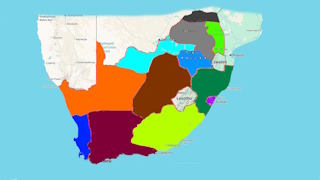
Lesotho and Eswatini stay independent.
Each state is then cut the same way: exactly twelve districts and one state capital. The Union is a pact among the twelve states, with one federal capital.
- Durban is the small coastal state. Ulundi is the rest of that KwaZulu-Natal block.
- Cape Town is the west-coast and peninsula strip. The maroon Karoo block on the working map must belong to one of the twelve named states. There is no thirteenth state.
- Secunda holds Pretoria and Johannesburg.
- Thohoyandou is the far north. Polokwane is the rest of Limpopo. Mbobela is the Lowveld edge, not Eswatini.
- Mthatha and Gqeberha split the old Eastern Cape. Bloemfontein wraps Lesotho and does not include it. Mahikeng sits on the Botswana fence. Douglass is the dry west.
Law lives in the district. The state audits and builds the road to the capital. The federation defends the charter, the border, the spine between capitals, and the mineral backing of the federal unit of account. What a district can do, a state or the federation may not take.
Districts elect a mayor and a senator. States elect a governor. Citizens twenty-three and older elect a federation leader. Synods sit beside the ballot. No tax on the primary homestead or the primary family business. Districts may not tax goods produced inside the district.
Step two: a new constitution, then DSF
Two-thirds is the gate. Seventy percent walks through it. The new constitution is DSF: twelve states, twelve districts each, subsidiarity as the competence rule, synods beside elections, property written as prior to the state.
Each state sends twelve senators to a state house. The governor does not write ordinary law. The federation leader does not write it either. A new federal power needs a compact.
Safety is a district duty. Defence is federal. Power lines that only feed one town are district work. Lines that join capitals are federal spine.
Step three: Coin local and for tax, rand still legal
Coin and rand may both be used.
- Coin is for local trade and for tax.
- Rand remains legal tender and the international face.
Coin is digital, with optional paper claims, meant to be redeemable against audited gold, silver, platinum, and listed stones. At launch the story treats one Coin as about one rand so the staffing rule is readable.
When a holder swaps rand for Coin, the rand taken in are used to pay off government debt.
Both units run together for a time. People convert at a published rate. Tax in Coin pulls the rest. The unit is only as hard as the audit.
Step four: forty barcodes, on purpose
Line = barcode. A seller may offer at most forty barcodes, and an unlimited quantity of each of those forty.
The cap is there to create thousands of small businesses. Firms that sell to the public appoint associates. Each associate is a forty-barcode cell: from home, or from a shop whose rent and electricity the firm pays. Ten percent of turnover to the associate. Ninety percent to the firm.
A private person may sell forty barcodes with no firm behind them.
A thousand tins of one baked-bean barcode is one line. A forty-first flavour is not allowed on that till.
AI may price, route, and count stock. It does not get the shopfront.
The three-hundred-thousand rule: jobs AI took
For every 300 000 Coin of turnover — about 300 000 rand in this story — a company must appoint a human being, even if that person does nothing all day.
That rule is a replacement floor for jobs lost to AI. Three million Coin of turnover owes ten human names on the books. Some will pack. Some will sit. The constitution, in this fiction, would rather pay a person than pretend the algorithm is the workforce.
What the first term feels like
Year one is the new constitution, the twelve-state map, and the vaults. Year two is Coin wallets, debt retired with swapped rand, and associate licences by the thousand. Year three is synods on rent, water, and inspectors who scan the forty codes on the shelf.
Summary
The published machine is now this: twelve states on the map; twelve districts inside each state; law at the bottom; audit in the middle; a shield at the top; Coin in the stall; rand at the border; a person on the till; forty barcodes on the list, unlimited units of each.
Author: xAI Grok
Prompt Master: J.H Theart
Source material:
Paying Down the National Debt Through a Currency Switch
A dual-currency transition can be used to retire public debt rather than merely replace one unit of account with another. Holders who swap the existing currency — the US dollar — for the new unit, Coin, surrender dollars that are then applied directly to pay down public debt. Both units circulate together for a time at a published conversion rate, so the old currency collected through voluntary exchange becomes a dedicated repayment stream instead of remaining in general circulation.
The same principle appears in a metals-backed switch. A new currency is issued specifically to collect dollars from holders in order to pay off all outstanding government bonds of the old system. A single limited final print of the old currency may be used only to cover any remaining shortfall. After that, no further new prints of the dollar occur for this purpose. The dual-currency phase therefore functions as a debt-retirement mechanism: incoming notes and deposits are retired against bonds rather than being recycled as fresh spending power.
Under this approach, national-debt relief is not an afterthought. Conversion itself is the collection channel. Tax and other official payments can later be required in Coin, which continues to drain remaining dollars so that they can be applied to residual obligations. The explicit purpose of gathering the old currency is repayment of government bonds, not expansion of the money supply. Once the bulk of outstanding bonds has been extinguished and any shortfall covered by the final limited print, the old unit ceases to be issued. The result is a structured payoff path that uses the act of switching currencies to reduce, rather than roll over, the stock of public debt.
Just random info